
Case Files
The Karen Read Case
Our take on what happened.

KAREN READ SERIES

13 Videos
Research We Used For The Show
Case Documents
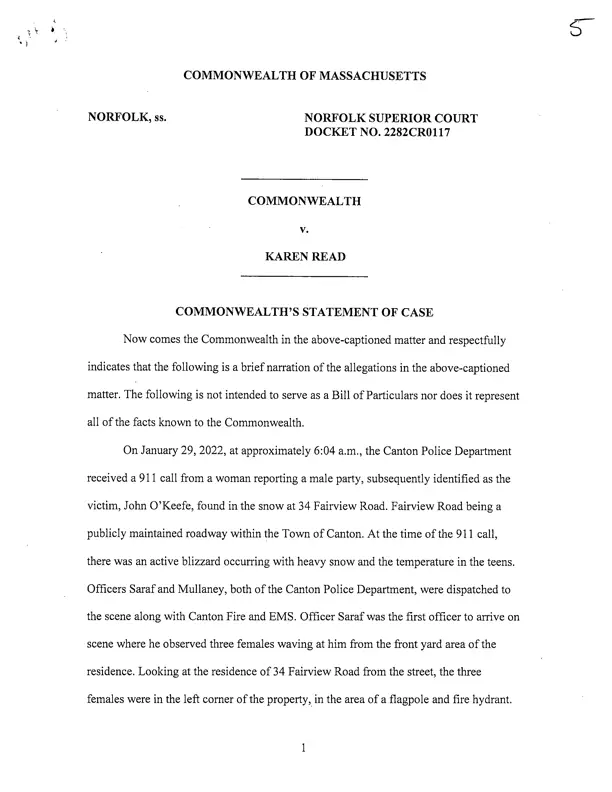
Karen Read Statement of Case
View Document

Town of Canton Police Department Independent Audit
Town of Canton PD Independent Audit
View Document

Matthew Farwell FBI Affidavit
Matthew Farwell FBI Affidavit — Sandra Birchmore Case
View Document

Sergeant Yuri Bukhenik
View Document
Brian Higgins
Brian Higgins
View Document
TFC Nicholas Guarino
View Document
The Full Investigation
A Tale of Two Closing Arguments
Karen Read Trial: An Infographic of the Closing Arguments

The Karen Read Trial

A Tale of Two Closing Arguments

Following a hung jury in a prior trial, the prosecution and defense presented their final, competing narratives in a high-stakes retrial over the death of Boston Police Officer John O'Keefe. This is a visual breakdown of their core arguments.

The Prosecution's Case

GUILT

Special Prosecutor Hank Brennan argued Karen Read was intoxicated, struck John O'Keefe with her SUV, and left him to die, a narrative built on physical evidence and her own statements.

The Defense's Case

DOUBT

Defense Attorney Alan Jackson asserted Read's innocence, claiming there was no collision and alleging a widespread police cover-up designed to frame his client.

Breaking Down the Commonwealth's Argument

Argument 1: The Fatal Sequence

The prosecution laid out a clear, linear chain of events, arguing that Karen Read's actions directly led to John O'Keefe's death. This timeline formed the core of their case.

"She was drunk, she hit him, then she left him to die."

- Special Prosecutor Hank Brennan

Argument 2: Physical Evidence at the Scene

Brennan emphasized that tangible evidence recovered from the scene corroborates their narrative of a collision, irrespective of any investigator misconduct.

🚗

Broken Taillight Pieces

🍸

Broken Cocktail Glass

Argument 3: The Legal Standard and Read's Admissions

The prosecution clarified that for a second-degree murder charge, they only needed to prove Read *intended the act* of reversing her car towards O'Keefe, not that she intended to kill him. They argued her own statements reveal her state of mind.

Key Statements Presented:

  • Heard by First Responders: "I hit him."
  • Read in a TV Interview: "I shouldn't have been driving."
  • Read on Video: "Could I have hit him? Did I hit him?"
  • SUV Data: Showed the vehicle reversed and accelerated.

The prosecution used these statements to argue that Read was "coming to terms with the moment" and that her questioning validated the testimony of first responders.

Breaking Down the Defense's Argument

Argument 1: The "No Collision" Foundation

The defense's case was built on one central premise: there is no direct evidence a collision ever occurred. Jackson argued this point created more than enough reasonable doubt.

Argument 2: A "Corrupted" Investigation

Jackson portrayed Read as a victim of a police cover-up, pointing to the misconduct of lead investigator Michael Proctor as proof that the entire investigation was unreliable and evidence was potentially planted.

Alleged "Ringleader"

Michael Proctor (Lead Investigator)

▼

Alleged Actions

Planted Evidence / Ignored Leads

▼

Result

Innocent Woman Framed

Argument 3: Alternative Injury Theories

The defense proposed other plausible causes for O'Keefe's injuries, arguing they were inconsistent with a vehicle strike and more consistent with an altercation and fall.

Argument 4: Confusion, Not Confession

Read's statement "I hit him" was re-framed by the defense not as an admission of guilt, but as a question born from the shock and trauma of the moment.

"Could I have hit him?
Did I hit him?"

A Question of Desperation

vs.

"I hit him."

A Statement of Fact

The Jury's Dilemma: A Stark Division

The previous trial ended in a hung jury, described as "starkly divided." This highlights the challenge the new jury faces: weighing two powerful, mutually exclusive narratives. The prosecution presents a case based on physical evidence and a clear sequence of events. The defense presents a case founded on reasonable doubt, alleged corruption, and alternative theories.

The verdict will depend entirely on which narrative is more compelling and whether the Commonwealth has proven its case beyond all reasonable doubt in the minds of the twelve jurors.

Stay In The Loop
Join The Mailing List
Control Zulu Dispatch — keep up with the latest news.